The town of Delft was a serene place, known for its namesake Delftware and the concentration of artists at the Guild of St. Luke. This flourishing cultural market emerged from the town's position in the midst of the Dutch Golden Age, an era when even middle-class families adorned their walls with portraits. It is estimated that around two-thirds of households possessed some kind of art.1 Dutch painters could sustain themselves through open market sales, unlike their counterparts elsewhere in Europe, who depended on aristocratic patronage or church commissions. The Guild of St. Luke reflected this prosperity, attracting talented artists who could make a respectable living painting grand civic portraits and intimate domestic scenes. In Delft alone, dozens of masters competed for commissions, each developing a distinctive style to stand out in an increasingly crowded marketplace.
Fig 1: Estimates of the number of painters and publishers active in the Dutch Republic, 1580–1700 (five-year moving average, semi-log scale)2
On the morning of October 12th, 1654, that serenity shattered. A gunpowder store exploded, devastating the prosperous town with the Delftsche Donderslag (the Delft Thunderclap), an explosion heard as far as Texel on the North Sea, some 150 kilometres away. Though much of the town was razed, relatively few casualties were recorded (possibly a hundred, though records were of course obliterated). Among them was Carel Fabritius, a relatively new but promising artist from Rembrandt's circle. Pulled alive from the rubble but succumbing to injury, his death cut short the career of an artist who, I believe, could have risen to the heights of Rembrandt himself.
 Fig 2: Egbert van der Poel: A View of Delft after the Explosion of 1654
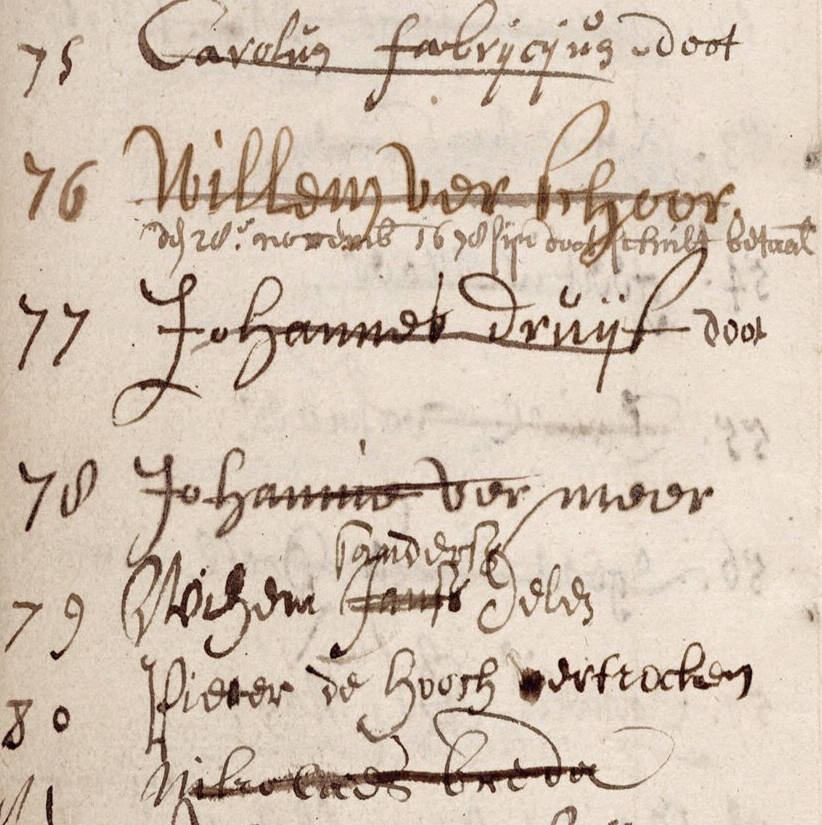 Fig 3: A detail of the Guild of Saint Luke register with Vermeer's name at number 78 and Pieter de Hooch's name at 80 and Carel Fabritius at 75.3
Carel Pietersz. Fabritius was baptised on 27 February 1622 in Middenbeemster. He was the eldest son of Pieter Carelsz., a schoolteacher and part-time painter, and the elder brother of Barent and Johannes, who also pursued painting careers. Around 1641 to 1643, Fabritius entered the Amsterdam studio of Rembrandt van Rijn, where he developed his early artistic style, deemed "a link between Vermeer and Rembrandt," by Thoré-Bürger.8
Rembrandt’s Studio
Following his teacher, he developed a refined technique, with broad and dark brushstrokes complemented by the dramatic lighting typical of Rembrandt’s style. Fabritius’ surviving paintings demonstrate technical mastery; he combined thin glazes with carefully placed areas of impasto to produce subtle effects of depth and texture. Owing to their stylistic resemblance to his master’s work, many of Fabritius’ early paintings were once sold as Rembrandt’s, sometimes bearing false signatures.
The Beheading of John the Baptist, Early 1640s
 Fig 4: Carel Fabritius, The Beheading of John the Baptist, Early 1640s4
This work, first circulated as a Rembrandt, represents the earliest works of Fabritius — history paintings — which followed the stylistic tendencies of his teacher. On the right stands Salomé, who — according to the biblical account — received the head of John the Baptist on a platter as her reward for dancing.
The execution hinges on the dramatic interplay of light and shadow, with an almost blinding "flood (almost a flash) of daylight" and "half shadows, textures" producing a convincing optical impression of space. Technically, The Beheading displays a masterful handling of the palette and the texture of both flesh and cloth, consistent with the treatment found in works like Mercury, Argus and Io. The head of the executioner is directly comparable to the artist’s own likeness in the National Gallery Self-Portrait. A distinctive technical feature is the use of a device to brightly illuminate the backs of the figures' hands. The treatment of the four nearest figures, especially, points to the mature vision of Fabritius in his later period.
Self-portrait, 1647-1648
 Fig 5: Carel Fabritius, Self-Portrait, Circa 1647–1648
“All this goes with the Rotterdam portrait of Fabritius, into a special category in which the portrait of a human being is transformed into something luminous and consoling.”
— Vincent Van Gogh, to Theo van Gogh. Saint-Rémy-de-Provence, on or about Monday, 2 September 1889.5
In this self-portrait, painted at around twenty-three years old, Fabritius presents himself with tousled curls falling to his shoulders and an open-necked shirt that reveals his chest hair, partially obscured by his work apron. He is set against a crumbling wall into which he scratched his signature while the paint was still wet. The portrait captures a young man who had already endured more than his share of hardship — he had recently survived the death of his young wife and all three of their children, returning from Amsterdam to grieve in his parents' home in Beemster. His piercing black eyes inspect us directly, and though he is young, his face shows the rugged features of someone who has lived a difficult life.
Fabritius's treatment of the background is what sets this work apart from his training under Rembrandt (documented by fellow pupil Samuel van Hoogstraten in his 1678 treatise Inleyding tot de hooge schoole der schilderkonst). He devoted as much care to painting the wall behind himself as to his own face, allocating far more space to the background than would normally appear in a portrait. Rembrandt would have emphasised the face and kept the background minimal; Fabritius painted a turbulent wall whose crumbling surface echoes the turmoil the young artist had endured. This attention to backgrounds would mark his later work and influence other Dutch artists.
Portrait of Abraham de Potter, 1649
 Fig 6: Carel Fabritius, Portrait of Abraham de Potter, 1649
Abraham de Potter sits in his black robes and ruffled collar, befitting a merchant of fine silks from Amsterdam. He was fifty-six when Fabritius painted this portrait, a lifelong friend of the artist's father and godfather to Carel's youngest brother and fellow painter, Johannes. This work and the Rotterdam self-portrait are the only two paintings signed by Fabritius during his six-year period in Beemster before his move to Delft, making them the only works from this time we can attribute to him with absolute certainty. Documentation suggests he received payments for other commissioned portraits during these years, indicating he was making a living as a painter, but none of those works survived.7
As with the earlier self-portrait, the most masterly element is the wall itself. Its rendering represents a substantial departure from Rembrandt's style, which would have favoured a bleaker, darker backdrop. Fabritius paints colours and textures that tell the story of an old wall while forming an aura around de Potter. This treatment presages the walls that would become characteristic of his later Delft paintings and influence the Delft school more broadly.
Between the title and signature, a trompe-l'oeil nail protrudes from the wall, complete with shadow. It serves no purpose except to declare that this is an actual wall (not a portrait background) and that the painter is indeed a master.
Delft Period
After the death of his first wife, Fabritius moved to Delft with his second wife in 1650. Influenced by the serene works of Delft masters like Vermeer, his portraits feature delicately lit subjects against light-coloured, textured backgrounds. Where Renaissance painting prioritised iconography, Fabritius turned to the technical aspects of painting, using cool colour harmonies to give shape to a luminous style.
View of Delft, 1652
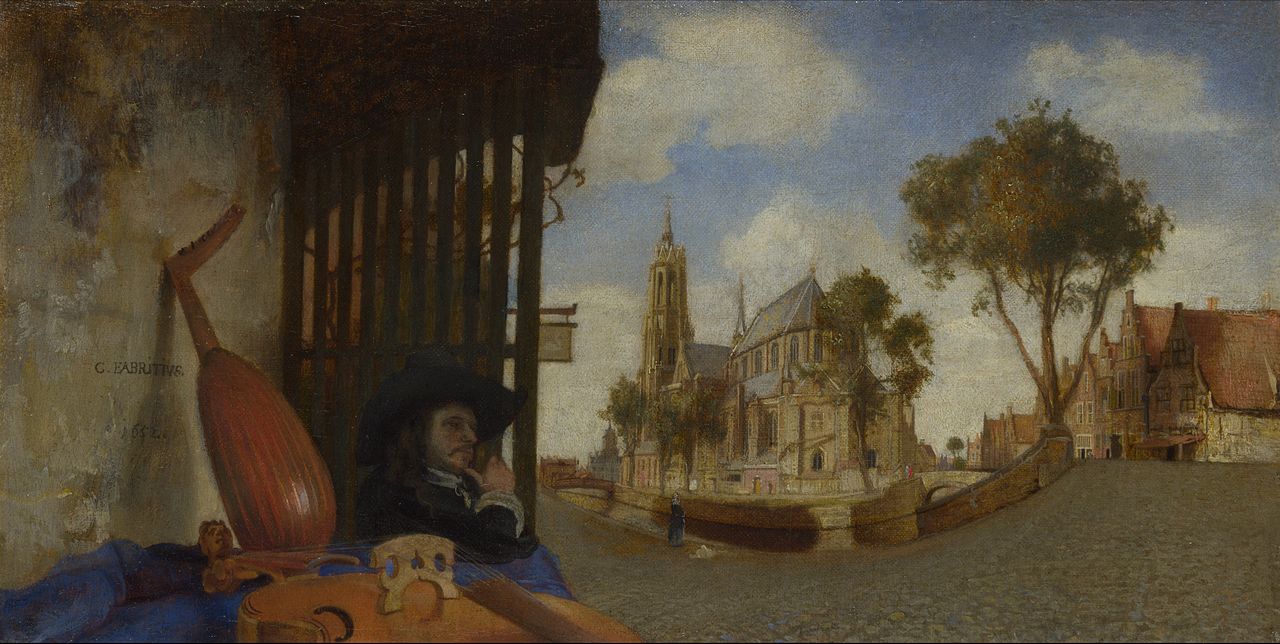 Fig 7: Carel Fabritius, A View of Delft, 1652
This is a very small and unusual painting, measuring just 15.5 × 31.7 centimetres, showing a view of the Nieuwe Kerk in Delft as though through a wide-angle lens. We look roughly north-west over a canal from the corner of two streets, the Oude Langendijk and Oosteinde. The grey shape just to the left of the church is the town hall. Both these buildings look much the same today, but the canal has been filled in and the houses on the right have been knocked down.7
Views of particular streets and buildings were popular in seventeenth-century Holland, especially in Delft where Fabritius worked. The exaggerated perspectives make this view unusual. The church, then and now the largest building in the city, appears roughly the same size as the houses on the right and the lute on the left. The church seems to loom towards us and the bend in the cobbled street appears to reflect the curve of a glass lens. The bridge in front of the church takes an unusually large space and seems to separate the merchant from the town.
The effect is most strongly emphasised in the two musical instruments set out on the table by a man who sits watchfully in the shade. He is probably a maker of, or dealer in, such instruments, and this is his stall. Fabritius uses a dramatically foreshortened view along the strings and fingerboard of a violin (or possibly a viola da gamba) so that the instrument appears extremely close to us. It follows the line of the street behind, which leads away from the centre of the picture, drawing our eye to the bulbous back of a lute leaning up against the wall. There we also see Fabritius's signature and date carved into the wall as though it were a piece of graffiti.
Together, the impression of the instruments' closeness, the church as centrepiece in the middle ground, and the lines of sight disappearing off into the distance on either side have led many art historians to conclude that Fabritius designed the image to create a specific optical illusion. During his lifetime, he was described as a "masterful painter of perspectives," and the commentator might well have been looking at this painting when offering that opinion. It was probably made to be fitted into a viewing box and looked at through a lens or peephole. This would have created an impression of depth, deceiving viewers into believing they were looking at a three-dimensional scene. This was known as a trompe-l'oeil effect (or trick of the eye), and several artists of the time specialised in such illusions. There's an example in the National Gallery's collection of what is known as a 'perspective box' of this type: A Peepshow with Views of the Interior of a Dutch House by Samuel van Hoogstraten, made about five or six years after this Fabritius painting.
What hasn't been definitively proven is exactly how Fabritius's view was intended to be mounted and looked at. The back of the painting is coated with a copper-protein complex, suggesting it was affixed to a copper plate with an animal glue and then curved to fit at the back of the device. When viewed through a small peephole in the box, the image would have been seen in proper perspective. All of the surviving perspective boxes from the time (none by Fabritius) were of interior scenes; this townscape would have stood alone. The painting may have been mounted on a curved surface inside the box, or perhaps viewed through a lens which created a particular optical distortion. However, no one has been able to replicate the image and put it in a box to successfully recreate that effect.6
The Sentry, 1654
 Fig 8: Carel Fabritius, The Sentry, 1654
This work presents itself as a simple scene of military life, yet its strangeness becomes apparent upon examination. A soldier has dozed off on a rough bench, his musket resting across his lap mid-loading. The architectural backdrop defies logic: a moss-covered pillar supports nothing, stairs climb towards an absent destination, and a carved relief of Saint Anthony and his pig adorns what appears to be an awkward hybrid of gateway and bridge spanning an empty moat. Barely visible beyond this structure lurks a partial figure — legs and a sword — painted over in the eighteenth century. The figure remained hidden until conservators uncovered it again in 2004-2005.
Perhaps Fabritius critiques the complacency that followed the 1648 Peace of Münster. The inclusion of Saint Anthony — traditionally associated with steadfastness — might highlight the guard's failure by contrast. Yet the most compelling explanation treats this as satirical commentary on negligence: whilst the sentry sleeps, an intruder penetrates the city's defences. The composition mirrors Nicolaes Maes's paintings of inattentive housemaids, transplanting domestic dereliction into a military context.
Whatever Fabritius intended, he created one of the strangest works of the Dutch Golden Age.
Young Man in a Fur Cap, 1654
 Fig 9: Carel Fabritius, Young Man in a Fur Cap, 1654
Though no contemporary documentation confirms the sitter's identity, this is almost certainly Fabritius himself. The direct stare and the stance recall a tradition established by Rembrandt and his circle, who frequently used themselves as subjects. The military breastplate follows this same convention — Rembrandt had depicted himself in similar martial dress during the 1630s.9
The headgear poses an interesting question. Later cataloguers labelled it fur, yet the loosely rendered curls suggest wool instead. It may have featured ear and neck flaps common to sailors' attire, and possibly soldiers' as well, though the indistinct brushwork makes certainty impossible.
Whether this was understood as a self-portrait at the time of creation mattered little. Likenesses of renowned masters like Rembrandt attracted collectors, but there was equally strong demand for tronies (character studies depicting various professions and types) for which artists routinely served as their own models. Fabritius was likely working within this commercial market, while using the exercise to refine his skills. Self-portraiture offered freedom to test new approaches and experiment with different expressions without the constraints of a commission.
A decade removed from Rembrandt's studio, Fabritius had clearly forged his own path. Gone are the deep shadows and dramatic chiaroscuro of his Amsterdam training. Rather than emerging from the murky darkness characteristic of Rembrandt's work, the figure here stands against a pale, overcast sky — an unconventional choice that generates its own tension, amplified by the low vantage point that positions us beneath the subject rather than at eye level.
The shift towards luminosity and atmosphere reflects his exposure to other painters in Delft, where Fabritius had settled in 1650, four years before this work was completed.
The Goldfinch, 1654
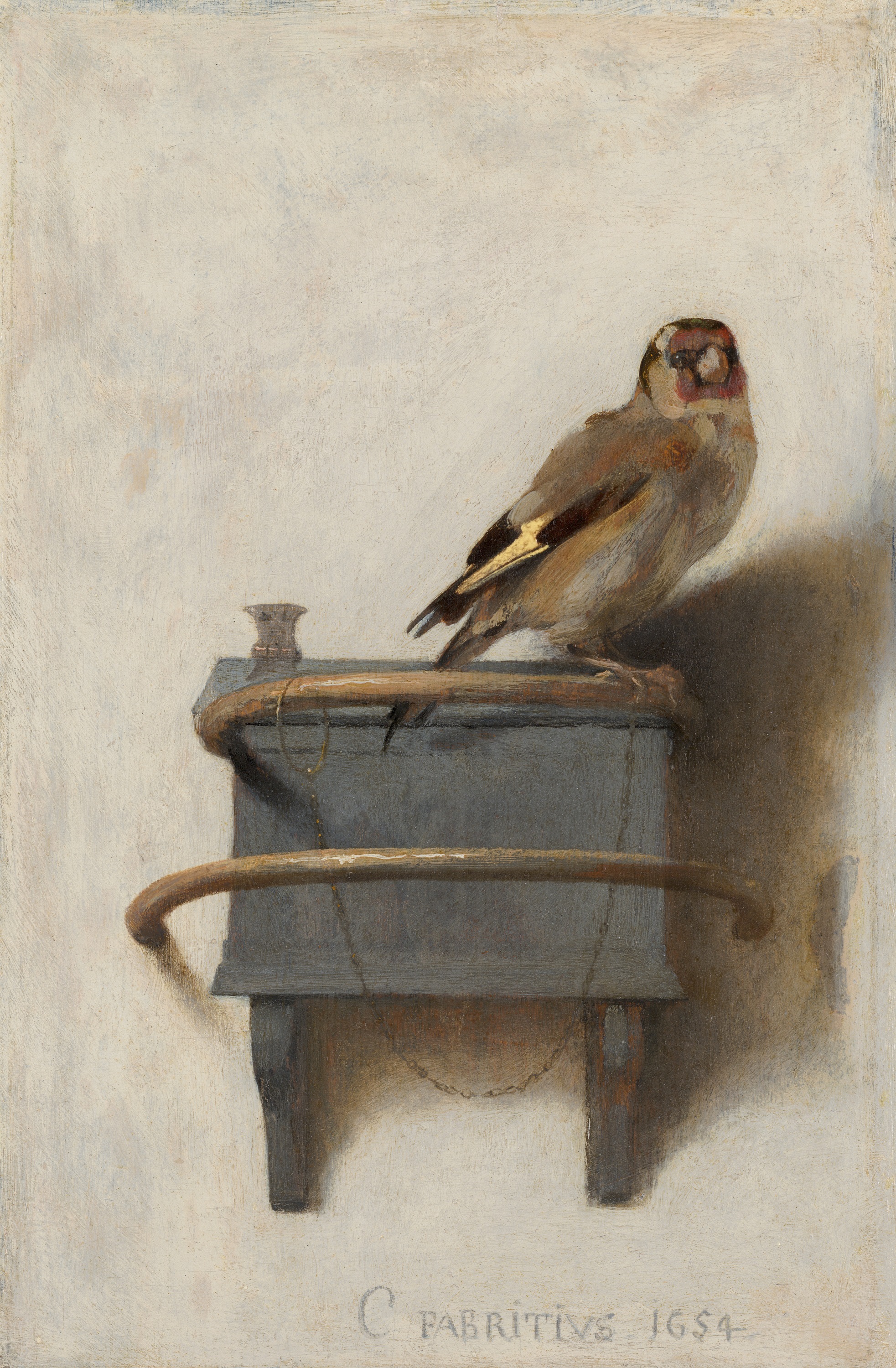 Fig 10: Carel Fabritius, The Goldfinch, 1654
The goldfinch appears frequently in Dutch painting, valued not merely for its vivid plumage but for its layered symbolism. Classical writers like Pliny linked the species to fertility — a connection perhaps referenced in Hieronymus Bosch's Garden of Earthly Delights, where an outsized goldfinch accompanies a naked couple.
This particular bird, a European goldfinch (Carduelis carduelis), stands chained to its feeding apparatus against a whitewashed surface. The Dutch called these birds puttertje, or 'water-drawer', for their remarkable ability to operate a miniature bucket on a chain, drawing water from vessels below. They could also manipulate their feeding boxes with their beaks — tricks that made them prized household companions in seventeenth-century Holland. Standard equipment for such pets included wall-mounted perches like the one shown here, often topped with an additional box shaped as a miniature stepped-gable house, with a platform below featuring a circular aperture through which the tiny bucket descended.
Fabritius rendered the creature with conspicuous energy. Individual brushstrokes remain distinctly visible, varying in thickness (in places building to substantial impasto). The small yellow feather cutting through the black wing creates a sharp chromatic punctuation. The red marking on the head, now somewhat faded, would originally have provided an even more forceful accent.
The work exists on a relatively thick small panel sawn from a much larger board, a detail that has generated considerable speculation about its original purpose. Some scholars propose it formed part of an elaborate three-dimensional cage structure, creating a trompe-l'oeil effect by combining painted and actual elements. The illusion would have been heightened by the interplay between flat imagery and physical construction. Another theory suggests it served as a cover for a wall niche, supported by the plastered appearance of the background and the low viewpoint, which implies observation from below street level. A third interpretation positions it as a protective door for a cupboard housing another painting, shielding the enclosed work from dust and deterioration. Such protective enclosures were commonplace in Dutch interiors of the period.
- Janson, J. The Dutch Economy of the Golden Age. Essential Vermeer. Available at: https://www.essentialvermeer.com/dutch-painters/dutch_art/ecnmcs_dtchart.html↩
- Rasterhoff C. The Markets for Art, Books, and Luxury Goods. In: Helmers HJ, Janssen GH, eds. The Cambridge Companion to the Dutch Golden Age. Cambridge Companions to Culture. Cambridge University Press; 2018:249-267.↩
- Janson, J. The Guild of Saint Luke of Delft. Essential Vermeer. Available at: https://www.essentialvermeer.com/saint_luke%27s_guild_delft.html↩
- Wright. C, The Dutch Painters: 100 Seventeenth Century Masters, London, 1978.↩
- This is tentatively attributed to Carel Fabritius, however I tend to go with Walter Liedtke’s attribution to Fabritius.↩
- Van Gogh, Vincent. Letter 798 to Theo van Gogh, on or about Monday, 2 September 1889. Available at: https://vangoghletters.org/vg/letters/let798/letter.html↩
- P. Sutton, Vermeer and the Delft Style (exh. cat. Tokyo Metropolitan Art Museum, 2 August - 14 December 2008), Tokyo 2008. Available at: https://www.codart.nl/images/JPTokyo2008VermeerTokyoMetropolitan.pdf↩
- Keith, L. 'Carel Fabritius' "A View in Delft": Some Observations on its Treatment and Display'. National Gallery Technical Bulletin Vol 15, pp 54–63. Available at: http://www.nationalgallery.org.uk/technical-bulletin/keith1994b↩
- See "Self-Portrait with Gorget" by Rembrandt: https://www.mauritshuis.nl/en/our-collection/artworks/148-portrait-of-rembrandt-1606-1669-with-a-gorget↩